In today’s digital world, online education is rapidly transforming. Just as technology is opening new avenues in every field, the system of learning is also no longer limited to traditional classrooms. Online education has made things easy for students across the world, where they can get quality education from any corner of the world while sitting at home. But this is just the beginning. Ultimately, online education is going to become even more advanced and engaging.
So many innovations are coming up that will completely change the way of learning of students. From Artificial Intelligence to Virtual Reality, new tools and platforms are proving to help personalize the lesson and match the individual learning styles of students. Similarly, blockchain technology is ensuring secure academic records of students, while trends like micro learning have people interested in increasing their knowledge through small lessons.
In this blog, we will explore some of the future trends that are changing the landscape of online education. These trends are not just a use of technology but are also proving to be a new way of making the lesson reach everyone. It is very important to understand how these innovations will affect students, teachers, and institutions in the coming times.
Rise of AI-Powered Learning Platforms:
Artificial Intelligence, i.e., AI, has now opened a new door in online education. With the help of AI, learning platforms have become so smart that they prepare customized lessons for each student by analyzing their behavior, speed, and way of understanding. If a student is struggling in any topic, AI automatically provides them with easy examples and additional resources. This not only makes learning faster but also every student gets guidance according to their need.
AI tutors and chatbots also provide 24/7 support to students, where they can ask their questions anytime and get answers instantly. This way, they do not have to wait for a teacher to be available. AI also checks assignments, identifies errors, and gives instant feedback, which is not possible in traditional teaching.
AI tools are helpful for teachers too, as they get detailed insights into student performance, which helps them create strategies for improvement. In the coming times, AI will become even more advanced, where a student’s understanding can be judged by facial expressions and voice tone. All these things are making online education personal and smart, where every learner gets lessons according to their specific needs.
Immersive Technologies: VR and AR in Classrooms:
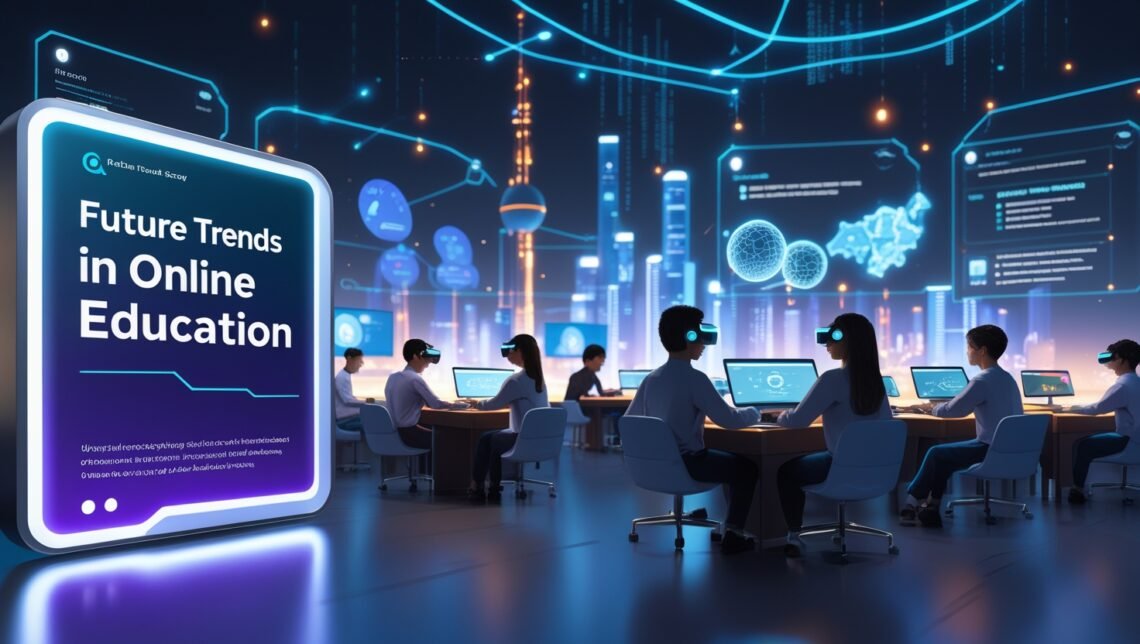
Virtual Reality (VR) and Augmented Reality (AR) are setting new standards in education. Earlier, students could learn only from books and videos, but now they can tour virtually any place. Imagine if a history student becomes a part of an ancient civilization and experiences that time, his understanding becomes even deeper. Similarly, science students can see a chemical reaction in 3D, which is how theory is understood practically.
By wearing a VR headset, the student is transported to a completely different world where he can even feel things. AR is a step forward where virtual objects are overlaid on the real world, such as viewing and interacting with a biological system on a mobile screen. These technologies make even boring subjects engaging.
Teachers can also design creative lessons using VR and AR. Group projects, simulations, and real-life problem-solving exercises improve students’ critical thinking and collaboration skills. Such experiments are difficult in traditional classrooms, but immersive technology is making them possible.
In the coming times, VR and AR will become cheaper and accessible, so that every student, regardless of whether he is from a city or a village, can be a part of high-quality and interactive learning.
Micro learning and Bite-Sized Education:
Micro learning means small lessons or modules that quickly cover a specific topic. This trend is perfect for people who have busy routines or have a short attention span. Nowadays, people want to understand something quickly and apply it, so micro learning has become quite popular.
Micro learning uses videos, quizzes, infographics, or short articles that are completed within 2 to 10 minutes. These small doses do not overload the student’s brain but improve retention. When a student understands a short topic, his confidence increases, and he takes more interest in learning the next lesson.
Mobile apps and online platforms are adopting this concept, where students can learn from their phones anywhere and at any time. For example, a student can complete a 5-minute micro-course even while travelling in the metro.
This approach is also very useful in training and corporate learning, where employees are taught new skills in short sessions. In the coming time, micro learning will become more personalized, where AI will recommend content according to your interests and needs. In this way, online education is becoming flexible, convenient, and effective.
Blockchain for Secure Credentials and Transcripts:
Blockchain technology is no longer just confined to cryptocurrencies, but is also being used in education. The biggest challenge for students of online education is to provide proof of their certifications and degrees. Blockchain solves this problem, where students’ academic records become secure and tamper-proof.
Blockchain is a decentralized ledger system where no unauthorized person can change any document once it is uploaded. This means that if you have taken a certificate in any course, it will be recorded on the blockchain, and its link or verification code can be shared with any employer or institution.
This will not only end fraud and fake degrees but will also make cross-border education easy. If a student does a course in one country and applies for a job in another country, their credentials can be easily verified.
Universities and online platforms are also adopting blockchain systems, which reduce administrative costs and increase transparency. In the coming days, blockchain will play a key role in making education more reliable, fast, and trustworthy. This innovation is making the world not only digital but also secure.
Global Classrooms and Multilingual Access:
An important advantage of online education is that students are no longer confined to their city or country. The concept of global classrooms has been introduced, where students from across the world can learn on a single platform. This leads to cultural exchange, understanding different perspectives, and enriching the learning experience.
Multilingual access is another important part of this system. Not every student speaks English, so platforms are now offering content in multiple languages. This accessibility also opens up learning for those who were previously held back due to language barriers.
Tools like Zoom, Google Meet, and Moodle have made real-time discussions and collaborations possible. Today’s student can gain knowledge by connecting live with any expert at any time. Group assignments and discussions give students an opportunity to learn from each other.
With multilingual subtitles, AI-powered translations, and region-specific content, now every student is getting lessons in their mother tongue. In the times to come, online education will become even more inclusive, where learners from every background can learn according to their language and pace. Global classrooms and multilingual support are truly making lessons accessible to the whole world.
Conclusion:
The future of online education seems very bright and dynamic. The way new technologies such as AI, VR, AR, blockchain, and micro learning are being integrated into education systems is not only making the learning experience easy but also more engaging and effective. Every student can achieve learning according to his/her learning style, speed, and interest, which was just a dream earlier.
In this digital era, education is not just limited to privileged people but is reaching every person in every corner of the world. Global classrooms and multilingual access now give everyone the opportunity to be a part of education regardless of language, time, or location.
It is also important that institutions and governments are ready to adopt these technologies and train students to use these tools correctly. Just having technology is not enough, it is also important to find its correct and productive use.
In the times to come, online education will become more inclusive, personalized, and interactive, where learning will not become just a duty but an enjoyable and lifelong journey. Those who will quickly adopt these changes will be able to move ahead, while those who will stick to the old ways will be left behind. This new journey of Taleem is opening new doors for every learner – we just have to accept it with an open heart.