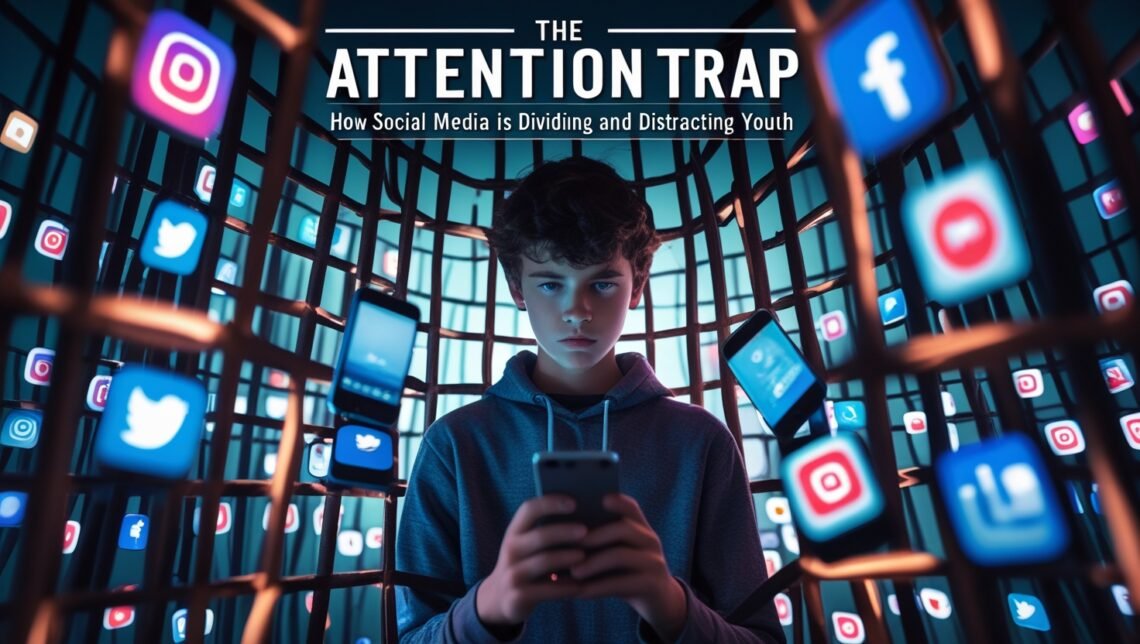
In the twenty-first century, wealth has taken on a new form. It is no longer measured only in land, gold, or bank balances. The most valuable resource of our time is not oil or data alone, but something far more subtle: human attention. In a world flooded with information, what you give your focus to has become a currency, one that fuels billion-dollar industries, decides political outcomes, and shapes the lives of millions of young people.
The Harsh Reality of Youth and Unemployment;
India is the youngest country in the world, with more than 808 million youth. On paper, this should be a blessing: a workforce ready to innovate, build, and power the economy. But the ground reality tells a different story. A PhD holder today is competing for the job of a sweeper, while influencers on social media earn 70 to 80 lakhs per month. This contrast highlights the imbalance between education, opportunity, and what actually creates wealth in the digital age.
The question naturally arises: how can someone with years of education struggle for survival, while a teenager with a smartphone becomes a millionaire? The answer lies in attention. Influencers and creators are not selling products; they are selling your eyes, your time, and your focus. Brands and platforms monetize this attention, turning it into hard cash.
Social Media as the Marketplace of Attention:
According to a Red She Strategy report, Indians spend an average of 7.3 hours a day on their screens, more than Americans (7.1) and Chinese (5.3). What dominates this screen time is not learning or productivity, but social media. And here lies the key: the more time you spend, the more money platforms and influencers make.
There’s a famous saying: “If you are not paying for the product, you are the product.” Social media platforms are not free out of generosity. They are designed to trap your attention, keep you scrolling, and expose you to ads, controversies, and viral content that ensures you return for more.
Controversy as a Business Model:
Consider the infamous Elvish Yadav and Maxton controversy. A midnight brawl turned into a viral sensation. Soon after, the two appeared together in a music video. What looked like a feud was nothing but a carefully staged publicity stunt. Millions of youth followed the drama, waited for updates, and fueled online discussions. When the video dropped, it collected millions of views in a single day.
This is not a coincidence; it is the business of attention. Fights, scandals, and controversies are the cheapest way to capture public focus. They polarize audiences into “supporters” and “haters,” ensuring that both sides stay glued. And every minute of that attention translates into money, fame, and influence for the people at the center of it.
Polarization – The Engine of Attention:
Max Fisher, in his book The Chaos Machine, explains how social media rewires our brains to thrive on division. Polarization is the splitting of society into opposing groups, supporters of one influencer versus another, left wing versus right wing, rich versus poor. On platforms like Instagram and YouTube, even hashtags like “I Stand With…” become tools for polarization.
But while we fight online battles for people who may never even know our names, our own lives remain stagnant. Polarization is not just a social issue; it is a business model. Divide people, capture their attention, and then sell it to advertisers.
The Dangers of Fake Attention Seeking:
The hunger for attention can drive people to extremes. Take the case of the influencer Gibson, who faked having brain cancer to gain sympathy, followers, and donations. For months, she documented her “struggle,” collected money, and built an online presence until the truth came out. The scandal destroyed her career and reputation.
Closer to home, Indian influencers often stage fake deaths, fake fights, or exaggerated controversies just to trend. The sad part is not just the deception, but the fact that millions of people fall for it, investing their time and emotions in something that adds no value to their lives.
Attention Sold to the Highest Bidder:
Attention is not only captured for music videos or social media fame. Increasingly, it is being sold to promote gambling apps, betting platforms, and addictive content. Many influencers, once they gain large audiences, start endorsing betting apps disguised as “games.” For young followers in small towns and villages, these endorsements look trustworthy. The result can be devastating debt, depression, and even suicide.
One tragic case in Visakhapatnam revealed how a young man ended his life after losing heavily on a betting app promoted by influencers. What began as entertainment ended as a disaster, all because attention was monetized irresponsibly.
The Contrast with China:
Interestingly, the same short video apps that flood India with soft–porn dances and brainless memes are heavily regulated in China. There, platforms like Douyin (the Chinese version of TikTok) only allow growth-oriented content, technology, science, creativity, and education. Content that promotes nudity or polarization simply does not go viral.
This shows us a crucial truth: algorithms are not neutral. They can be designed to uplift or to degrade. India’s youth are trapped in a loop of distraction because the algorithm here pushes addictive, non-productive content. Meanwhile, Chinese youth are guided toward constructive skills. The difference in outcomes is obvious.
The Shrinking of Human Attention
Psychologist and Nobel laureate Herbert Simon once said: “A wealth of information creates a poverty of attention.” Never has this been truer than today. With endless scrolling, humans now have an attention span shorter than that of a goldfish, eight seconds compared to nine.
A study by the University of California found that if you interrupt your work to check your phone, it takes an average of 23 minutes to return to a state of deep focus. Imagine how much productivity and potential are being wasted simply because our attention is being hijacked.
Choosing Where to Invest Your Focus:
Ancient philosophers like Epictetus warned us: “Keep your attention focused on what is truly your own concern. What belongs to others is none of your business.” Yet today, millions of youth are more concerned with influencer feuds than with their own studies, careers, or families.
It is not wrong to follow creators or enjoy entertainment. The danger lies in misinfluence when you allow controversies, fights, and shallow trends to dominate your mind. History is clear: violence and hate have never built civilizations. They only destroy.
On the other hand, attention invested in growth pays lifelong dividends. Reading, learning, exercising, and building relationships are areas where focus multiplies value. Oprah Winfrey famously said, “Where focus goes, energy flows.” The law is simple: whatever you give your attention to expands in your life.
Conclusion:
The real question is not whether attention is a currency. It already is. The real question is: Who is spending your attention, and on what? If you allow influencers, brands, and platforms to decide for you, they will spend your attention for their profit, not your benefit.
But if you consciously choose where to invest it in knowledge, skills, relationships, and self-improvement, then attention becomes the most powerful tool for building the life you desire.
In a world overflowing with distractions, guarding your focus is an act of rebellion. Remember: money lost can be earned back, time lost is gone forever, but attention wasted is the slow death of potential.
Attention is not just a currency. It is life itself.
FAQs:
Why is attention called a currency in the digital age?
Attention is called a currency because, just like money, it is limited and highly valuable. Social media platforms, advertisers, and influencers compete for your focus since your time spent on their content directly translates into revenue. The more attention you give, the more money they earn.
2: Why are influencers earning more than highly educated people today?
Influencers are not selling traditional products; they are selling your attention. Brands pay them to capture and direct your focus toward ads, apps, or trends. A PhD may struggle to find a job because the modern economy rewards visibility and engagement more than degrees alone.
3: How does social media manipulate human attention?
Social media platforms are engineered to keep users scrolling. They push controversies, fights, and addictive trends because these trigger strong emotions and polarization, which glue people to screens. Every like, share, and argument is a way to keep your attention trapped.
4: What are the dangers of attention misuse?
When attention is exploited, it can lead to fake controversies, gambling addictions, debt, depression, and even suicide. Misused attention distracts youth from education and growth, trapping them in cycles of unproductive behavior that benefit platforms and influencers but harm individuals.
5: How can we take control of our attention?
The key is to invest attention consciously in areas that bring long-term value such as reading, learning, exercising, building skills, and relationships. By reducing distractions and avoiding manipulative trends, individuals can reclaim focus and use it to build a better future.